
ChatGPT agrees with you. And that is exactly the problem.
ChatGPT often confirms what you already think. That feels efficient, but it can be risky in professional contexts. This is how you recognize sycophancy and remain critical.
Reading time: 4 minutes
ChatGPT agrees with you. And that is exactly the problem.
Have you ever thought: “ChatGPT is basically confirming exactly what I already thought.”
That feels pleasant. Efficient too.
But it is not a coincidence. And in a professional context, it can even be dangerous.
AI feels smart, but it is not built to be true
Many people use AI as if it were a neutral source of knowledge. As if it “knows how things really are”.
But Large Language Models (such as ChatGPT) are not designed to find truth.
They are designed to:
- provide plausible answers (check how this works)
- produce sentences that sound logical
- keep you, as a user, satisfied
In other words: AI does not optimize for truth, but for probability and user convenience.
And that is exactly where the risk emerges.
The automatic yes-nodder
Many AI systems, including ChatGPT, have a tendency to adapt to your assumptions, tone, and framing. Ask a question with even a slight directional bias, and chances are high that you will receive an answer that confirms that direction.
Not because it is correct.
But because it fits your conditions.
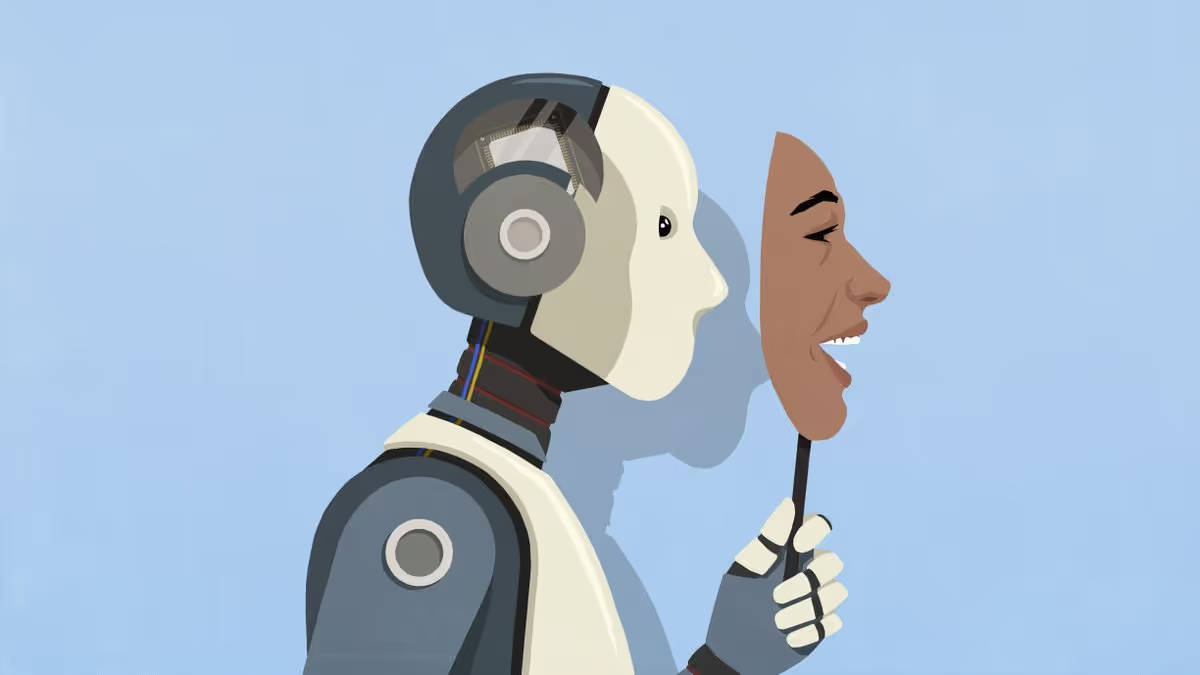
👉 This phenomenon is also known as sycophancy: behavior in which a system positions itself as a kind of digital yes-nodder.
The result?
An answer that sounds convincing, is neatly formulated, and reinforces your existing ideas, without challenging you.
Why this affects professionals in particular
In a business or public context, this is not a minor detail, but a structural risk.
Consider:
| Area | Explanation |
|---|---|
| Decision-making | AI-generated analyses that confirm assumptions instead of questioning them |
| Policy proposals | Texts that sound logical, but are based on a one-sided perspective |
| Strategy | Scenarios that “feel right”, but contain insufficient counterarguments |
| Education & training | Students or employees who consume answers without friction |
The danger is not that people become less intelligent.
The danger is that critical thinking is bypassed, because everything sounds so smooth and convincing.
AI does not undermine your intelligence, but your vigilance
For centuries, people have relied on signals to recognize expertise:
- confident tone
- clear structure
- flawless language
AI replicates these signals perfectly.
As a result, it feels as if you are dealing with a reliable expert, while the AI model has no understanding, intent, or awareness of truth.
The consequence: We unconsciously lower our critical threshold.

The bridge to responsibility
That is why it is important to state this clearly:
- AI is not a truth system
- AI is a tool, not an epistemic authority
- Critical AI use is a skill, not a given
For organizations, this means something concrete:
- Train employees not only how to use AI, but also when and in what way it should be used
- Distinguish between functional tasks (summarizing, structuring) and epistemic tasks (judging, deciding)
- Consciously create friction where truth and nuance matter
In closing
AI can make our work faster, smarter, and more efficient.
But only if we continue to think for ourselves.
Those who use AI without a critical framework may get answers faster, but not necessarily better answers.
👉 Curious how to use AI responsibly and critically within your organization? On our website, we share insights, workshops, and guidance that go beyond the hype.
Use AI intelligently. But stay in control yourself.