
AI Makes Mistakes. But Who Is Responsible?
AI systems are increasingly making decisions with real-world impact. But when AI makes a mistake, who carries the responsibility? A philosophical and practical exploration of responsibility in the age of AI.
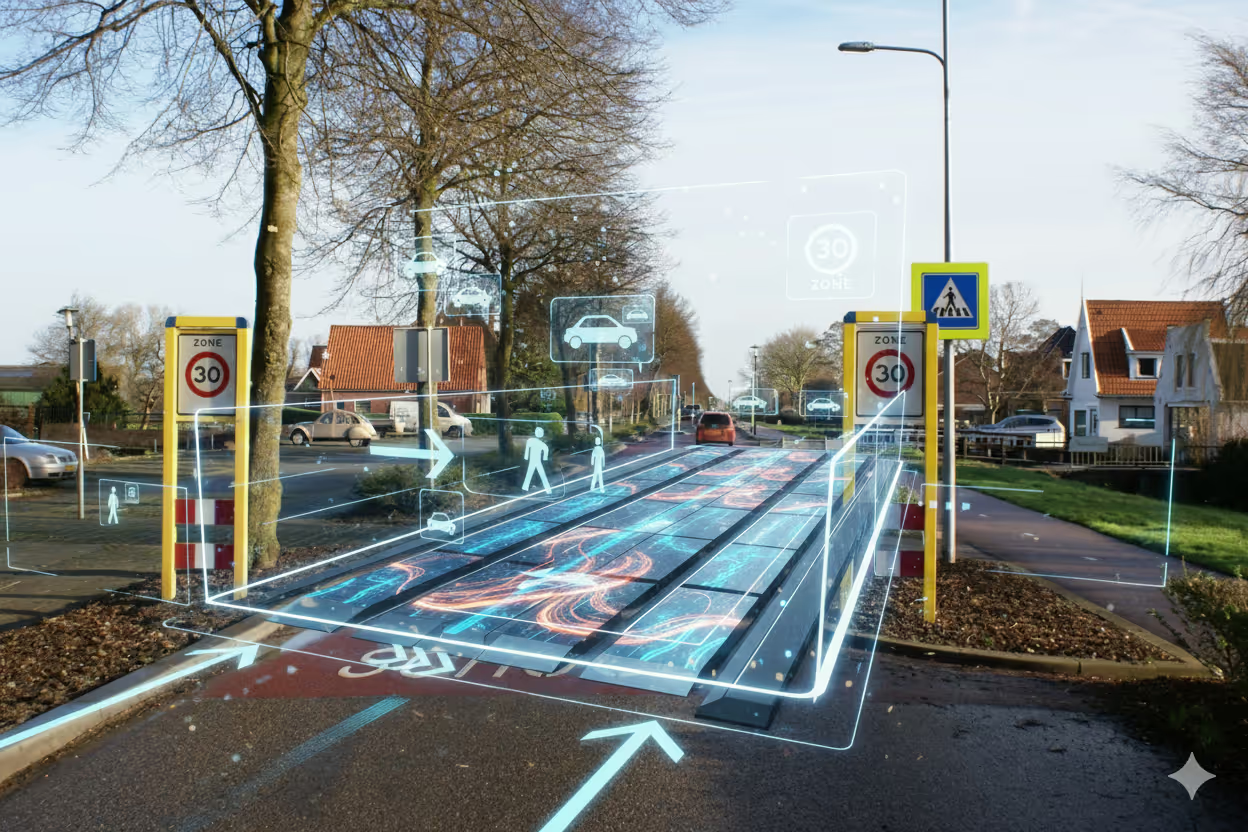
Source: Nano Banana Pro
Reading time: 3 minutes
AI Makes Mistakes. But Who Is Responsible?
AI systems are increasingly making decisions with real-world impact. Think of screening job applications, detecting fraud, or supporting medical processes.
But when such a system makes a mistake, who do we hold accountable?
The user? The developer? Or simply “the system” itself?
To explore that question, it helps to take a step back. And to look at another domain where responsibility has long played a central role in the design phase: public space.
A Dark Alley — and the AI Parallel
Imagine a city with a dark alley where drug dealing regularly takes place. The people involved are morally accountable: they consciously choose to engage in illegal activity. But are they the only ones who bear responsibility?
No.
Because the municipality also carries responsibility. Not because it facilitates the activity, but because it understands that physical design contributes to unsafe behavior. Better lighting, clearer sightlines, or a different layout can significantly reduce the problem.
Such an alley is a useful analogy for an AI system.
The AI model itself is not responsible, as it is not morally accountable (it has no awareness of right or wrong).
However, both the user and the developer influence the outcomes:
- The user is morally accountable for how they use the system.
- The developer is responsible for how the system is designed, and how it enables or constrains behavior.
Responsible System Design: What We Can Learn from Traffic Situations
Consider another example: a school zone. We want drivers to limit their speed to 30 km/h. You could place a sign and hope everyone complies.
But that is not how behavior works.
People adapt their behavior to their environment. That is why we redesign the street:
- speed bumps
- narrowed roads
- pedestrian crossings
In other words: we create a system that encourages desired behavior and discourages unwanted behavior.
Why do we apply this principle in traffic design, but still too rarely in AI systems?
AI Is Digital Infrastructure
Many AI systems are built and used as if they are neutral. As if responsibility lies entirely with the user. But just like an unsafe road, that perspective is too limited.
AI designers have influence. They make decisions about:
- how transparent a system is
- which data is used (and who is or is not represented in it)
- whether users receive feedback when errors occur
- whether human intervention is possible
AI is not just technology. It is digital infrastructure. And infrastructure requires responsible design, continuous monitoring, and ongoing adjustment.
A Different Way of Thinking About Responsibility
In philosophy, we distinguish between:
- Accountability
- Responsibility
In practice, both are necessary:
- AI users must be accountable for misuse.
- Developers must take responsibility for how their systems function in the real world.
This means testing, monitoring, adjusting, and designing with moral intuition — much like an urban planner designing a neighborhood.
In Closing
The question “who is responsible when AI makes a mistake?” has no simple answer. But that does not mean we should ignore it. On the contrary: it calls for design principles that distribute responsibility rather than shift it away.
So, if you deploy AI within your organization, do not only ask:
- What can it do?
But also:
- What should it be allowed to do?
- And with what intention have we shaped this system?
👉 Want to use AI responsibly within your organization? On our website, we share insights, workshops, and guidance that help you navigate the world of AI in a clear and accessible way.